What a second costs on PixVerse
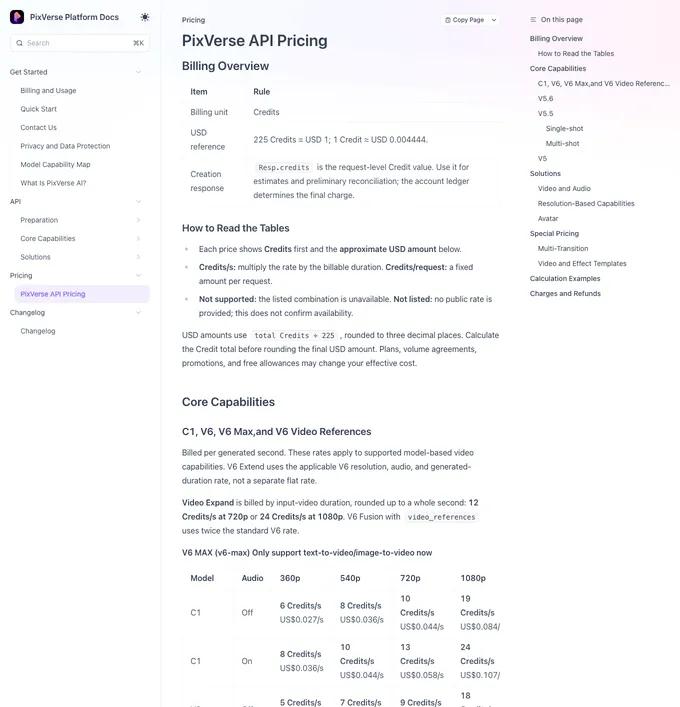
PixVerse (docs.platform.pixverse.ai) prices generation in credits per second and prints a credit reference alongside, so the conversion is arithmetic rather than a guess: 225 credits are put at one dollar, and V6 without audio runs 5 to 18 credits a second from 360p to 1080p. As of 2026-10-25.
| Tier | In credits | Per second | Longest clip |
|---|---|---|---|
| V6 360p | 5 credits | $0.022 | not stated |
| V6 540p | 7 credits | $0.031 | not stated |
| V6 720p | 9 credits | $0.040 | not stated |
| V6 1080p | 18 credits | $0.080 | not stated |
Inclusion rule. Tiers the vendor publishes a per-second rate for. A tier priced only as a monthly allowance is not converted and does not get a row. Order. As the vendor orders them on its own page.
1How many priced tiers each channel publishes
| Channel | Priced tiers published |
|---|---|
| Dreamina | 1 tier |
| fal | 4 tiers |
| Kling AI | 3 tiers |
| LTX Studio | 1 tier |
| MiniMax | 4 tiers |
| Novita AI | 5 tiers |
| PixVerse | 4 tiers |
| Replicate | 3 tiers |
| Runware | 8 tiers |
| Runway | 1 tier |
| SceneMixer | 11 tiers |
| Sora | 5 tiers |
| Veo | 7 tiers |
| Vidu | 3 tiers |
| Wan | 3 tiers |
| WaveSpeed AI | 7 tiers |
Inclusion rule. Channels that publish a per-second rate, or a credit rate together with a credit price. Tiers are counted as the pricing page itself breaks them out. Order. Alphabetical by channel name.
2Both halves of the price are public, which is why this row exists
A credit rate on its own is not a rate, because nothing says what a credit costs. Here the page puts 225 credits at one dollar and prints an approximate dollar figure beside every rate, so the per-second figures in the table are the credit rate divided by a number the vendor prints rather than one this site chose.
The single reference is worth noting on its own. The page lists no packs and no volume tiers, so there is one conversion rather than a range. It also calls the dollar amounts approximate and says plans, volume agreements, promotions and free allowances may change the effective cost, so the reference is a list rate and not what every buyer pays.
3Audio and extras are priced per second as well
The figures in the table are for output without audio. Lip sync, sound effects, restyling and upscaling are each published as their own credits line, most of them per second, so a finished shot can carry several of them at once and the arithmetic stays additive.
That structure is unusually legible: because everything is per second in the same unit, a production can price a shot by adding the lines it actually uses instead of choosing a bundle and hoping it fits.
4What the pricing page does not state
No maximum clip length appears beside the per-second models, so the clip column is recorded as not stated. Earlier model generations are published with fixed durations instead of a per-second rate, and those are a different unit that is not folded into this table.
The price page itself says only that a failed task should be checked against the account ledger and that refunds may be delayed. The FAQ beside it says qualifying failed, moderated or timed-out tasks may be refunded, without saying which ones qualify, so the failure column records a refund that is possible rather than a rule.
5Sources
Read from the platform pricing published at docs.platform.pixverse.ai, checked 2026-10-25. How credits are converted to dollars is on the method page; every channel side by side is on the ledger. What PixVerse publishes in the other columns: price of a credit. Next along the ledger: Dreamina, fal.
- The credit reference rate; the page lists no packs and no volume tiers225 credits are put at one US dollar
- V6 at 360p without audio5 credits per second
- V6 at 720p without audio9 credits per second
- V6 at 1080p without audio18 credits per second
- What a failed generation costsQualifying failed, moderated or timed-out tasks may be refunded, with the refund shown in the account ledgerstated in the FAQ and billing guide beside the price page