What invideo AI publishes about price
invideo AI (invideo.io) publishes three plans with monthly credit allowances, and quotes approximate credits for a five-second generation on named models. The quantities are approximate and no credit price is stated, so the arithmetic does not close. As of 2026-09-12.
| Item | On the page |
|---|---|
| Plan prices per seat | Published |
| Monthly credit allowance per plan | Published |
| Approximate credits per five-second generation | Published |
| Exact credits per second | Not published |
| A price per credit | Not published |
Inclusion rule. Items a per-second rate would need, plus what the vendor publishes instead. Items no vendor in this field publishes are not listed. Order. Published items first, then the missing ones.
1Approximate is the word that decides this row
A figure printed as approximate is a guide to planning, not a rate. Recording it as one would put a number in a comparison table that the vendor itself declines to state exactly, and every reader downstream would treat it as firm.
The approximation is reasonable on the vendor's side: credit consumption on a generation can depend on settings the plan page does not enumerate. It is exactly that dependence which makes the figure unusable as a rate.
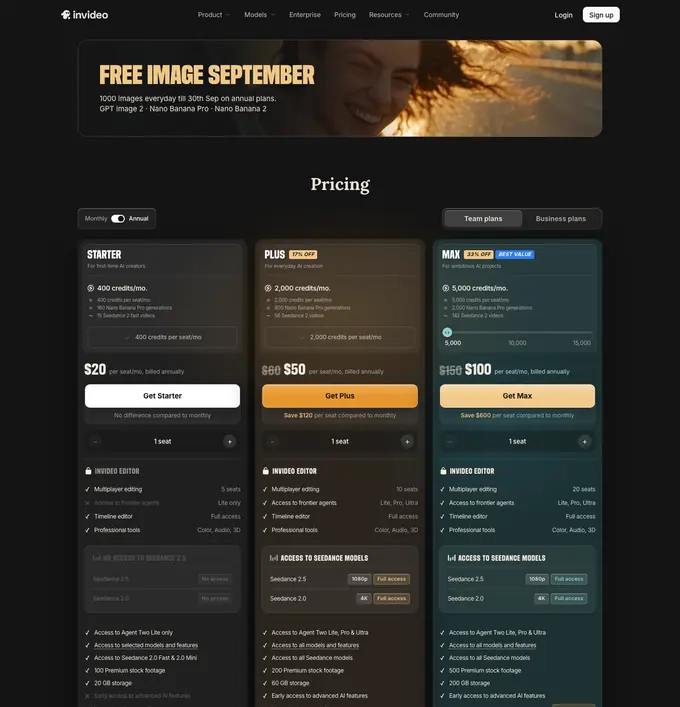
2Per-seat pricing points at a different buyer
Plans sold per seat are shaped for teams that produce continuously, where the question is how many people need access rather than how many seconds get generated. That is a coherent product and a different unit from everything on the ledger.
A production costing a single season against a per-seat plan has to decide how many months the season occupies, which is a scheduling assumption rather than a price.
3What would put this on the ledger
Credits per second stated exactly rather than approximately, and a price per credit. The plan structure would not have to change for either to be published.
4The production behind the price
Price aside, what goes into the seconds behind “invideo AI” is described in SceneMixer's guides:
Typically 60–120 seconds, always 9:16 vertical, ending on a hook. SceneMixer's episode outlines are generated with that pacing, and setting a project to 9:16 makes every segment vertical (the default is 16:9).
SceneMixer, How to Make ReelShort-Style Dramas with AI — “How long is a ReelShort-style episode?” (read 2026-10-13)
Video is 16:9 landscape by default, with 9:16 vertical available; you set it once per project. Segments are typically 4 to 15 seconds, and some model tiers go to 30.
SceneMixer, AI Short Drama Generator — “What length and aspect ratio does it output?” (read 2026-10-13)
5Sources
Read from invideo.io, checked 2026-09-12. What this register accepts as a published rate is on the method page; the channels that do publish one are on the ledger. What invideo AI publishes in the other columns: unused credits. Also without a published rate: CapCut, Hedra.
- What invideo AI publishes instead of a rateMonthly credit allowances, with credits quoted per video