What CapCut publishes about price
CapCut (capcut.com) does not print a price on the page that answers what it costs. The help centre states that pricing varies by region, device and promotion, and directs the reader to the subscription screen inside the application. As of 2026-09-12.
| Item | On the page |
|---|---|
| That a paid tier exists | Published |
| That credits are consumed by AI features | Published |
| That price varies by region and device | Published |
| A price anyone can read without signing in | Not published |
| A per-second figure | Not published |
Inclusion rule. Items a per-second rate would need, plus what the vendor publishes instead. Items no vendor in this field publishes are not listed. Order. Published items first, then the missing ones.
1A price behind a sign-in is outside what this register can hold
A figure earns a row here by carrying its origin: which vendor page held it, on what day. That is what makes a reader able to go and disagree with it. A number visible only inside an application, and different by region and device, cannot carry either.
This is not a claim that the price is high or low. It is a statement about what can be verified from outside, which is the only thing this register claims to track.
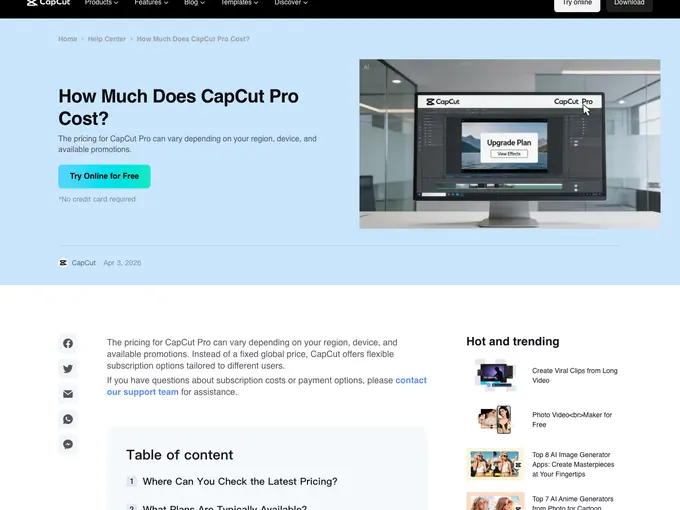
2Region-varying prices are common and rarely stated so plainly
Several products in this field price differently by market without saying so. Stating it openly is more useful than a single figure that turns out to hold in one country, even though it means no row here.
For a production budgeting across markets, that sentence is itself the finding: the cost of this channel is a local question, and a figure quoted by someone in another country does not transfer.
3What would put this on the ledger
A public page stating a price for at least one named region, with the unit it buys. A single readable figure with its condition attached would be enough.
4Inside a generated second
Price aside, what goes into the seconds behind “CapCut” is described in SceneMixer's guides:
The Seedance 2.0 tiers render segments up to 15 seconds; use a Seedance 2.5 or Wan tier for 30-second takes.
SceneMixer, Seedance 2.0 Fast — “Does Fast render 30-second takes?” (read 2026-10-13)
The shots add up to more than the selected video tier allows for one segment.
SceneMixer, Shot Seconds: Changing Timing, and the Limits — “What does 'over cap' mean on the segment card?” (read 2026-10-13)
5Sources
Read from capcut.com, checked 2026-09-12. What this register accepts as a published rate is on the method page; the channels that do publish one are on the ledger. Also without a published rate: Hedra, HeyGen.
- Where CapCut says its price can be readPrice shown in the app, stated to vary by region and device