What Morph Studio publishes about price
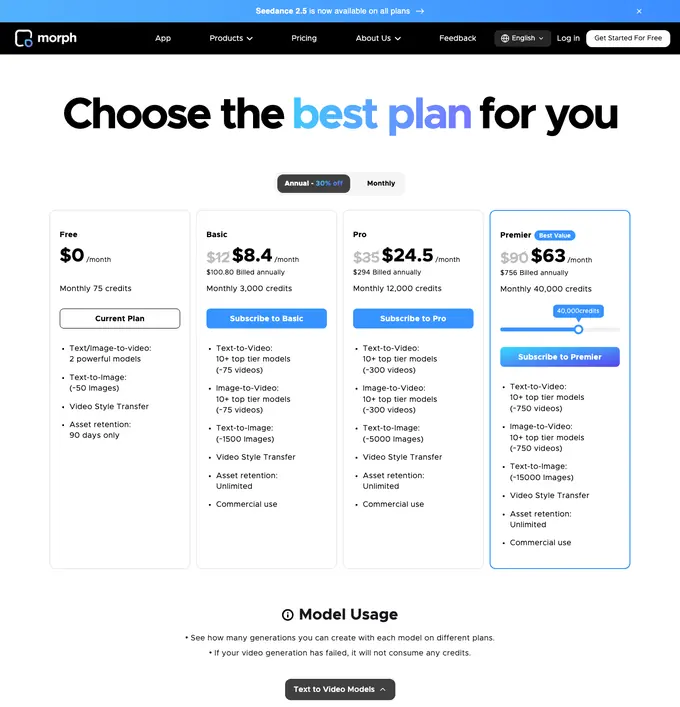
Morph Studio (morphstudio.com) publishes four plans with a monthly credit allowance on each, and describes usage in videos rather than in seconds. No credit price and no per-second figure appear, so nothing on the page converts to a rate. As of 2026-09-12.
| Item | On the page |
|---|---|
| Plan prices, monthly and annual | Published |
| Monthly credit allowance per plan | Published |
| Generation counts described per model | Published |
| Credits per second | Not published |
| A price per credit | Not published |
Inclusion rule. Items a per-second rate would need, plus what the vendor publishes instead. Items no vendor in this field publishes are not listed. Order. Published items first, then the missing ones.
1A quota is a budget, not a price
A plan with an allowance tells a buyer how much they may generate this month. It does not tell them what a second costs, because the same allowance buys different amounts of output depending on which model and resolution consume it.
That makes the plan easy to budget against and hard to compare. A production that knows its monthly volume can pick a plan from this page in a minute; a production comparing this channel against a metered one cannot do it from the page at all.
2Counting in videos hides the variable that matters
A count of videos is only a cost figure if the videos are the same length, and generated clips are not. Two productions on identical plans can deliver very different runtimes, which means the published unit does not track the quantity being bought.
Per-second pricing exists in this market precisely because runtime is the thing that scales. A channel that prices per video is making a different bet about how its buyers work.
3What would put this on the ledger
Either a per-second figure, or credits per second together with a price per credit. A count of videos with no duration attached does not become a rate however it is arranged.
4The production behind the price
Price aside, what goes into the seconds behind “Morph Studio” is described in SceneMixer's guides:
Measured across every job that finished successfully on scenemixer.com in the thirty days to 20 September 2026: analysis of a whole book runs about 2 minutes 49 seconds at the median, one episode's storyboard 1 minute 54 seconds, one video segment 3 minutes 20 seconds, and compositing an episode 3 minutes 52 seconds.
SceneMixer, Turn a Novel into a Video Series with AI — “How long does it take to produce one episode?” (read 2026-10-13)
A segment is one generation, and its length is the sum of its shots’ seconds.
SceneMixer, How to Change a Segment’s Duration, and Which Tiers Accept 30 Seconds (read 2026-10-13)
5Sources
Read from morphstudio.com, checked 2026-09-12. What this register accepts as a published rate is on the method page; the channels that do publish one are on the ledger. What Morph Studio publishes in the other columns: unused credits. Also without a published rate: invideo AI, CapCut.
- What Morph Studio publishes instead of a rateMonthly credit allowances only