What Pika publishes about price
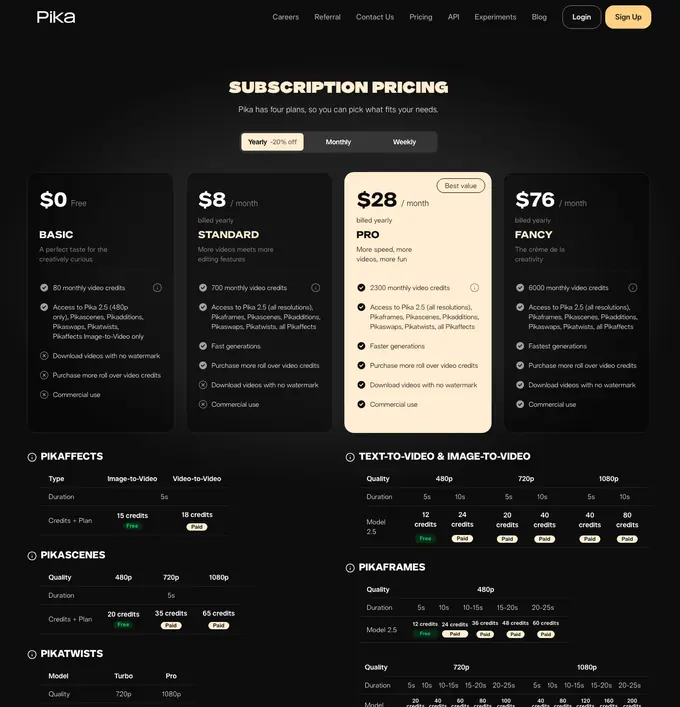
Pika (pika.art) publishes plan prices with a monthly credit allowance, and credit costs attached to features rather than to seconds. Neither a credit price nor a duration is stated, so there are two missing halves rather than one. As of 2026-09-12.
| Item | On the page |
|---|---|
| Plan prices | Published |
| Monthly credit allowance per plan | Published |
| Credits per feature | Published |
| Credits per second | Not published |
| A price per credit | Not published |
Inclusion rule. Items a per-second rate would need, plus what the vendor publishes instead. Items no vendor in this field publishes are not listed. Order. Published items first, then the missing ones.
1Feature pricing and duration pricing answer different questions
A figure attached to a feature says what an action costs. A figure attached to a second says what output costs. A production planning a season needs the second one, because the quantity it is buying is runtime.
Converting between them needs to know how much output one use of the feature returns, and that is not on the pricing page. Two missing numbers do not combine into an estimate; they compound.
2Where feature pricing is the more honest shape
For work that is genuinely per-action rather than per-minute, pricing by feature describes the product better than a rate would. A tool used to alter existing footage is bought by the operation, and a per-second figure would be the awkward fit.
That is worth saying because the absence of a rate here is not necessarily a gap in disclosure. It can be a product that is not sold by the second, and this register records the shape rather than grading it.
3What would put this on the ledger
Credits stated per second of output, and a price per credit. Either alone leaves the conversion resting on an assumption, which is the line this ledger does not cross.
4The production behind the price
Price aside, what goes into the seconds behind “Pika” is described in SceneMixer's guides:
A serialized vertical-video show (typically 60–120 seconds per episode, 9:16) where the cast, scenes, and footage are AI-generated.
SceneMixer, The AI Micro Drama Production Pipeline — “What is an AI micro drama?” (read 2026-10-13)
The shot seconds in the storyboard add up to the segment length, so editing them changes it.
SceneMixer, Fixing One Shot Without Redoing Everything — “Can I change the duration of a segment?” (read 2026-10-13)
5Sources
Read from pika.art, checked 2026-09-12. What this register accepts as a published rate is on the method page; the channels that do publish one are on the ledger. What Pika publishes in the other columns: unused credits, price of a credit. Also without a published rate: Morph Studio, invideo AI.
- What Pika publishes instead of a rateCredits by feature, with no credit price