What Luma publishes about price
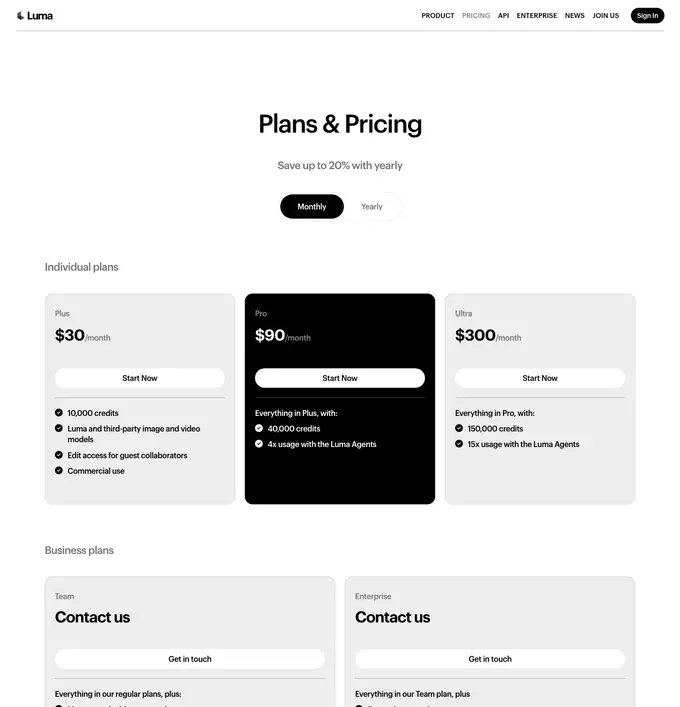
Luma (lumalabs.ai) publishes credits per second for each model and resolution, which is half of a rate. The other half, what a credit costs, is not published: the page states plan prices and the monthly credit allowance each plan carries, and those two numbers are not a credit price. As of 2026-09-12.
| Item | On the page |
|---|---|
| Credits per second, by model and resolution | Published |
| Plan prices | Published |
| Monthly credit allowance per plan | Published |
| A price per credit | Not published |
| A per-second figure in currency | Not published |
Inclusion rule. Items a per-second rate would need, plus what the vendor publishes instead. Items no vendor in this field publishes are not listed. Order. Published items first, then the missing ones.
1Why a plan allowance is not a credit price
Dividing a plan price by its monthly allowance gives a figure, and the figure is only correct for a buyer who uses the allowance exactly. Use less and the real cost per credit is higher; use more and the overage terms decide, not the division.
So the arithmetic is available to anyone and the answer is conditional on a behaviour nobody publishes. This register records the credit rate, records that the credit price is missing, and stops there rather than picking a usage assumption on the vendor's behalf.
2What is genuinely useful here anyway
The credits-per-second figures are comparable to each other, so the relative cost of models and resolutions inside this one product is legible even without a dollar figure. A production deciding between two models on this channel can settle that question from the page.
What the page cannot settle is a comparison against a channel that prices in currency. That comparison needs the missing half, and no amount of care with the half that exists supplies it.
3What would put this on the ledger
One sentence stating what a credit costs, on a page anyone can read. That is all. The credit rates are already public and already per second, so the conversion would be arithmetic rather than an estimate the moment the second number appeared.
4The production behind the price
Price aside, what goes into the seconds behind “Luma” is described in SceneMixer's guides:
Video is 16:9 landscape by default, with 9:16 vertical available; you set it once per project. Segments are typically 4 to 15 seconds, and some model tiers go to 30.
SceneMixer, AI Short Drama Generator — “What length and aspect ratio does it output?” (read 2026-10-13)
Segments are numbered within their episode and the numbering is maintained for you when you insert or delete one.
SceneMixer, What Is Inside a Project — “Can I reorder segments?” (read 2026-10-13)
5Sources
Read from lumalabs.ai, checked 2026-09-12. What this register accepts as a published rate is on the method page; the channels that do publish one are on the ledger. What Luma publishes in the other columns: price of a credit. Also without a published rate: Pika, Morph Studio.
- What Luma publishes instead of a rateCredits per second, with no credit price